Who are the top sunroom contractors in Maryland?
Finding the right sunroom contractor in Maryland comes down to three things: verified MHIC licensing, proven project management, and experience building for Maryland’s four-season climate. The contractors below represent the strongest options available to Maryland homeowners in 2026, each evaluated on service area, sunroom types, materials, and how they handle permitting.
| Contractor | Service Area | Sunroom Types | Key Credentials | Permitting | Best For | Rating |
|---|---|---|---|---|---|---|
| Maryland Sunrooms | Baltimore, Frederick, Gaithersburg, Hagerstown, Silver Spring, Bethesda, Columbia | 3-season, 4-season, all-season enclosures | Guild Quality member, Energy Star certified, factory trained | Full permit and inspection management | Broad Maryland coverage with strong warranty | 4 stars |
| Cedarbrook Outdoor Design/Build | Mt. Airy and surrounding Maryland region | 3-season, 4-season, porch enclosures | TimberTech Platinum Pro, NADRA certified, FCBIA Best Outdoor Space | Full project management including permits | Premium craftsmanship, high-end 4-season builds | 5 stars |
| MHIC Licensed Contractors | Statewide Maryland | Varies by contractor | MHIC regulatory certification | Permitting authority per Maryland code | Code compliance and consumer protection | — |
Key distinctions at a glance:
- Maryland Sunrooms has operated since 1997 and serves the widest geographic footprint across the state.
- Cedarbrook Outdoor Design/Build brings more than two decades of experience and numerous completed projects, and a workmanship warranty on carpentry.
- Any contractor you hire must hold a valid MHIC license, the Maryland Home Improvement Commission credential that authorizes residential construction work statewide.
How do these Maryland sunroom builders compare on services and materials?
The real differences between top Maryland sunroom builders show up in construction methods, material systems, and how they manage your project from permit to punch list.
Maryland Sunrooms partners directly with a national sunroom manufacturer, using aluminum framing, glass, and wood systems engineered for energy performance. Their shared project calendar gives homeowners real-time visibility into every phase, and their free in-home design consultation sets expectations before a single permit is filed. Their full project management covers consultation, structural engineering, permit management, and final finishing.
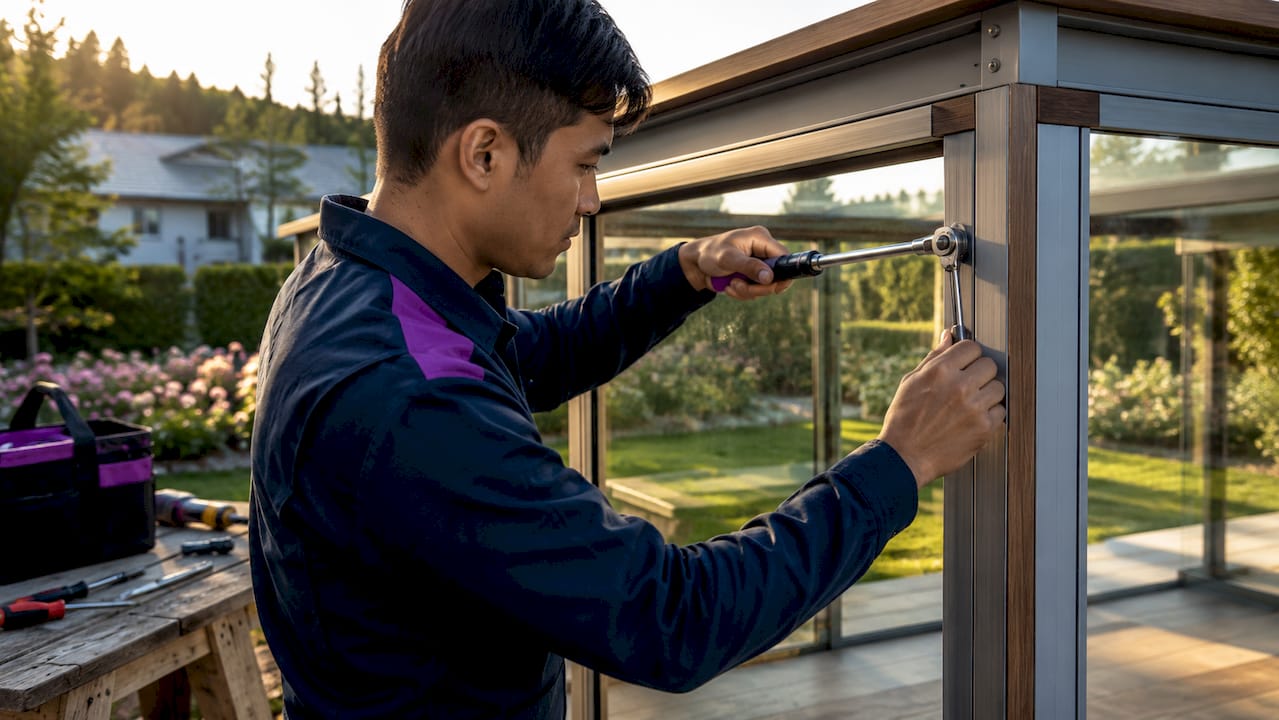
Cedarbrook Outdoor Design/Build takes a master carpentry approach, building with premium materials suited to Maryland’s humidity and temperature swings. Their TimberTech Platinum Pro certification reflects factory-level training on one of the most durable decking and framing systems available. Beyond the 10-year workmanship warranty, they offer a lifetime warranty on alternative-framed porches and a 3-year warranty on hardscape work. That layered warranty structure is worth asking about specifically when you compare contractors.
What to compare when reviewing contractor proposals:
- Whether the contractor uses stick-framing, aluminum systems, or panel systems like Eze-Breeze by PGT
- How warranties are split between workmanship coverage and manufacturer product coverage
- Whether the contractor handles county-level permitting directly or passes that responsibility to you
- The consultation process: free in-home design visits versus phone-only estimates
One detail many homeowners overlook: warranty structures differ between carpentry workmanship and manufacturer product warranties. A contractor may offer a strong labor warranty but limited coverage on the glass or panel system itself. Ask for both documents before signing.
How to choose the right sunroom contractor in Maryland
The single most important credential to verify is an active MHIC license. Maryland law requires any contractor performing home improvement work to hold this license, and you can confirm it directly through the Maryland Department of Labor’s online database. No license means no legal protection if something goes wrong.
Beyond licensing, evaluate contractors on these criteria:
- Industry certifications: TimberTech Platinum Pro, NADRA membership, and National Sunroom Association affiliation all signal ongoing professional training.
- Local permitting experience: Maryland’s county-level zoning rules vary considerably. A contractor who has pulled permits in your specific county moves faster and avoids costly code revisions.
- Project management scope: The best contractors handle design, structural engineering, permitting, inspections, and finishing as one integrated process.
- Warranty clarity: Get the workmanship warranty and the product warranty in writing, separately.
Questions to ask every contractor before you commit:
- Are you currently licensed with the MHIC, and can I verify your license number?
- Will you pull all required permits and manage county inspections directly?
- What is your workmanship warranty, and what does the manufacturer’s product warranty cover separately?
- How do you handle design changes after the contract is signed?
- What is your realistic timeline from permit submission to project completion?
Red flags to watch for: A contractor who asks you to pull your own permits, offers a verbal-only warranty, or cannot provide proof of insurance is a contractor worth walking away from. Incomplete permit handling is one of the most common sources of delays and code violations on sunroom projects in Maryland.
Pro Tip: Before your first consultation, check the contractor’s MHIC license status at the Maryland Department of Labor website. It takes two minutes and tells you immediately whether the contractor is authorized to work on your home.
What standards govern sunroom construction in Maryland in 2026?
Maryland’s building code treats sunrooms differently depending on how they are classified. A three-season room, typically built with vinyl or aluminum panel systems like Eze-Breeze, does not need to meet conditioned living space standards. A four-season sunroom does. That classification affects foundation requirements, insulation specifications, HVAC integration, and the permit category your contractor files under.
Four-season sunrooms require specialized insulation, reinforced footings, and HVAC connections to remain comfortable through Maryland winters and summers. Contractors who specialize in this work understand that the foundation for a four-season room must support the combined load of heavy glass, insulated framing, and potential snow accumulation. Cutting corners on footings is one of the most common sources of structural problems years after a project closes.
The MHIC licensing framework exists precisely to protect homeowners from unlicensed work that bypasses these standards. Licensed contractors carry the legal authority to pull permits, which means they are accountable to county inspectors at every phase. An integrated design-build approach keeps the design team and construction crew aligned from concept through final inspection, reducing the risk of miscommunication that causes expensive mid-project corrections.
What custom sunroom styles work best for Maryland homes?
Maryland homeowners typically choose between three main sunroom configurations, each suited to a different use case and budget.
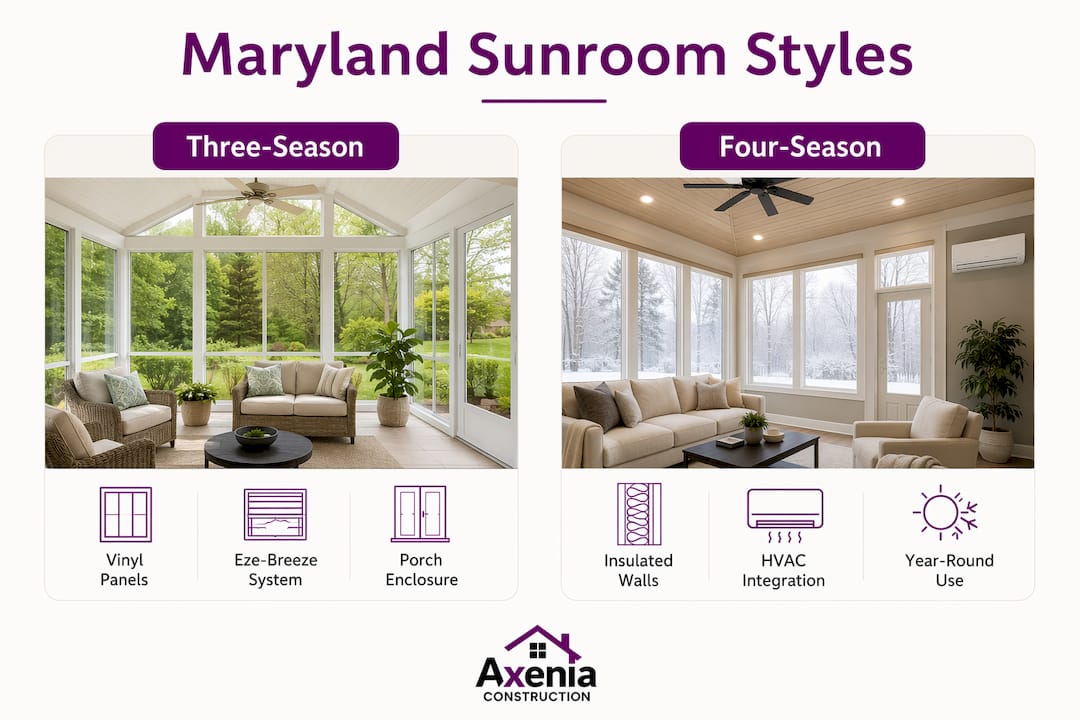
Three-season rooms use vinyl-glazed panel systems, often Eze-Breeze by PGT, to enclose a porch or deck. They open up to 75% of the window area for airflow in spring and fall, then close completely to block wind, rain, and insects. They are not insulated for winter use but work well for nine or ten months of the year in Maryland’s climate.
Four-season sunrooms are fully conditioned additions built to residential living space standards. They require insulated framing, proper foundations, and HVAC connections. These rooms function as true year-round living space and typically add the most value to a home.
Screened enclosures are the most affordable option, designed for warm-weather use with maximum airflow and no glass panels. They suit homeowners who want outdoor living space without the cost of a full enclosure.
Custom design elements, including vaulted ceilings, skylights, tile or hardwood flooring, and custom trim packages, are available across all three types from contractors like Cedarbrook and Maryland Sunrooms.
What does the sunroom installation process look like?
A professionally managed sunroom project in Maryland follows a clear sequence. Understanding each phase helps you set realistic expectations and hold your contractor accountable.
- Design consultation: Your contractor assesses the site, discusses your intended use, and produces a design plan with material specifications.
- Permit submission: The contractor files with your county building department. Permit timelines vary by county, typically running several weeks.
- Site preparation and framing: Foundation work, footing installation, and structural framing happen first. This phase is where four-season and three-season builds diverge most significantly.
- Enclosure installation: Glass, panels, or screens are installed along with roofing and flashing.
- Interior finishing: Flooring, electrical, HVAC connections, and trim complete the space.
- Final inspection: The county inspector signs off, and your contractor delivers the completed project.
Understanding Maryland’s permit requirements before your project starts helps you ask better questions and avoid surprises. Most sunroom additions require a building permit regardless of size.
How much does a sunroom cost in Maryland?
Sunroom pricing in Maryland varies widely based on type, size, and finish level. Screen rooms typically start around $8,000–$15,000. Three-season Eze-Breeze rooms generally range from $15,000–$35,000. Full four-season sunroom additions can run from $30,000 to $80,000 or more, depending on foundation complexity, glass specifications, and interior finishes.
The factors that push costs higher include reinforced footings for heavy glass systems, HVAC integration for four-season use, custom interior finishes, and county permit fees. Contractors who manage permitting in-house often reduce total project cost by avoiding the delays and resubmission fees that come with permit errors.
Get itemized written estimates from at least two contractors before committing. A detailed estimate separates material costs, labor, permit fees, and contingency, giving you a real basis for comparison.
How do you schedule a consultation with a Maryland sunroom contractor?
Most top Maryland sunroom builders offer free in-home design consultations. Maryland Sunrooms provides a dedicated design consultant who visits your home before any commitment. Cedarbrook Outdoor Design/Build can be reached at (301) 703-8728 and serves homeowners throughout the Mt. Airy region and beyond.
When you contact a contractor, come prepared with your intended use for the room, a rough size or footprint idea, and any photos of your existing porch or outdoor space. The more specific you are upfront, the more useful the consultation will be. Ask the contractor to confirm their MHIC license number during that first call. It is a simple request that any legitimate contractor will answer without hesitation.
Axeniaconstruction brings licensed general contracting to your sunroom project
If you are weighing your options for a home renovation in Maryland, Axeniaconstruction offers a different kind of partnership. As a licensed, women-owned general contractor based in Rockville, MD, we bring full project management, transparent communication, and genuine accountability to every build.

We specialize in residential renovations that require coordinated design, permitting, and construction, exactly the kind of integrated work a sunroom addition demands. Our team handles the complexity so you can focus on the result. Whether you are planning a three-season enclosure or a fully conditioned four-season addition, we are here to guide you through every phase with clarity and care. Explore our residential renovation services or contact us directly to schedule your consultation.
Key Takeaways
Choosing the right Maryland sunroom contractor requires verified MHIC licensing, clear warranty terms, and a contractor who manages permitting, inspections, and construction as one integrated process.
| Point | Details |
|---|---|
| MHIC licensing is required | Verify any contractor’s active MHIC license before signing a contract; it is the legal baseline for residential work in Maryland. |
| Three-season vs. four-season matters | Four-season sunrooms require insulated framing, reinforced footings, and HVAC integration; three-season rooms do not meet conditioned space standards. |
| Warranty terms need scrutiny | Ask for workmanship and manufacturer product warranties separately; they cover different risks and durations. |
| Permitting is the contractor’s job | Top Maryland builders handle all county permit applications and inspections directly, reducing delays and code risks for you. |
| Axeniaconstruction for integrated builds | Axeniaconstruction is a licensed Rockville-based general contractor offering full design-build project management for Maryland residential renovations including sunroom additions. |
Recommended
- Outdoor Living Space Design in Lanham, MD: Extend Your Home Beyond the Walls – Axenia Construction
- Top Home Remodeling Tips in Maryland for 2026: Boost Value & Comfort – Axenia Construction
- General Contractor in Rockville, MD: Professional Remodeling & Construction Services – Axenia Construction
- Deck Builder in Rockville, MD: Transform Your Backyard with Custom Outdoor Living Spaces – Axenia Construction