A basic bathroom refresh in Maryland typically runs $4,000 to $10,000, a mid-range remodel lands between $10,000 and $25,000, and a full gut remodel can reach $25,000 to $55,000 or more. The biggest swings in that range come from labor availability, plumbing or electrical moves, material choices, and permit requirements. Use the numbers below to interpret contractor bids, then compare itemized quotes and confirm licensing before you sign anything.
TL;DR:
- A mid-range bathroom remodel in Maryland typically costs between $10,000 and $25,000, with higher expenses near urban centers due to labor and permit complexities.
- Plumbing relocation can add $1,500 to $4,000 to the project, especially when moving supply lines or drain stacks, often the key variable between mid- and high-end costs.
- Contractors should provide separate bids for labor and materials, particularly for plumbing and tile, to identify potential scope creep and ensure accurate budgeting.
- Local market factors mean costs can vary significantly; for instance, Montgomery County averages $18,000 to $25,000, while rural areas can be 10-20% cheaper.
- Permits and licensed trades are mandatory for plumbing and electrical work, and verifying MHIC licensing before signing ensures protection against scope and workmanship disputes.
Table of Contents
- Statewide cost ranges and how to interpret them
- Component cost breakdown: labor, plumbing, tile, and fixtures
- Representative city examples across Maryland
- Permits, licensed trades, and inspections in Maryland
- How to compare quotes and set a realistic budget
- Axenia Construction’s take on Maryland bathroom projects
- Do you need a general contractor or can you manage subs yourself?
- What Axenia Construction offers Maryland homeowners
- Where to verify permits, fixtures, and ventilation rules
- Sources
- FAQ
Statewide cost ranges and how to interpret them
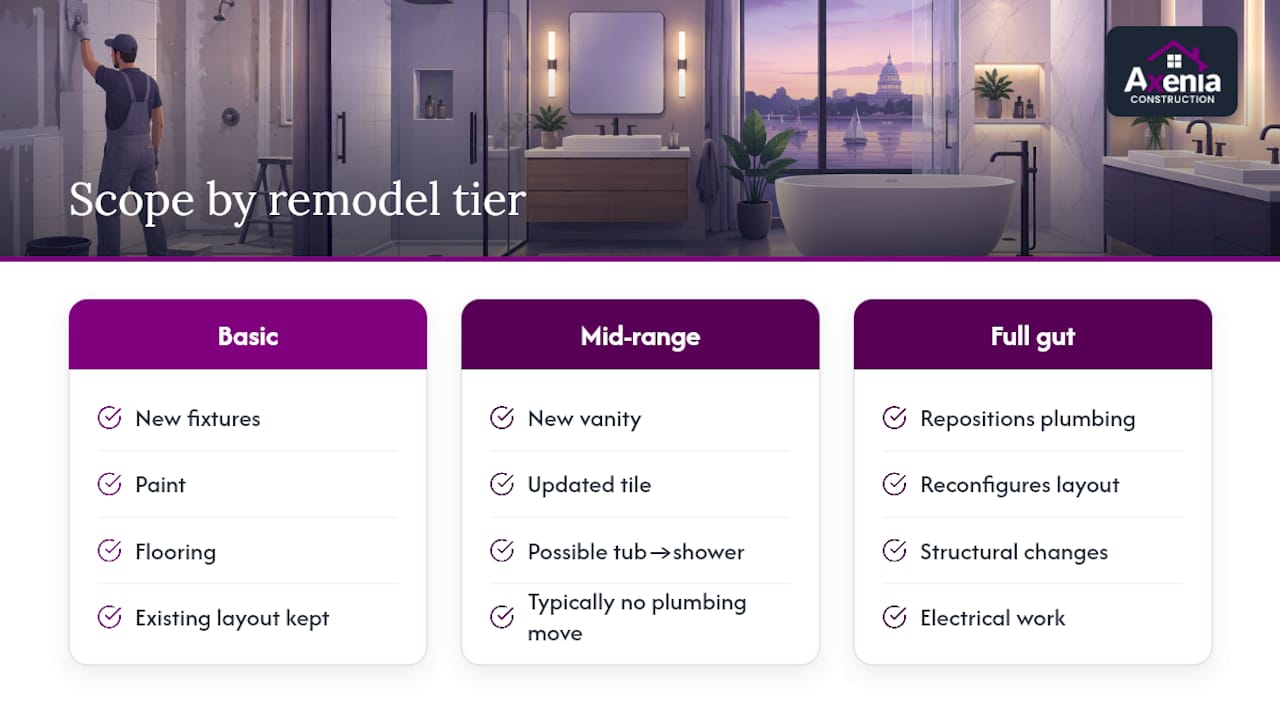
These bands describe scope, not just spend. A basic refresh usually means new fixtures, paint, and flooring with the existing layout untouched. Mid-range work adds a new vanity, updated tile, and possibly a tub-to-shower conversion. A full gut remodel repositions plumbing, reconfigures the layout, and often includes structural or electrical changes.
Two Maryland homeowners with nearly identical bathrooms can get bids that differ by thousands of dollars, and the reason is usually local labor rates and permitting complexity rather than material cost. Montgomery County and the DC-adjacent suburbs tend to run higher than rural Eastern Shore towns because skilled trade labor is in tighter supply near the capital region.
A mid-range Maryland bathroom remodel commonly falls in a range typical for similar projects in the area, which reflects new fixtures, tile, and a vanity without moving plumbing lines. Homeowners planning around that midpoint should still request itemized bids, since a single plumbing relocation can push a mid-range project toward the high end of its band.
Component cost breakdown: labor, plumbing, tile, and fixtures
Materials and fixtures make up the rest, and that split is where most homeowners either save money or overspend without realizing it.
- Toilet replacement: $300 to $800 installed, more for a comfort-height or WaterSense-certified model.
- Vanity installation: $500 to $2,500 depending on size, material, and whether plumbing shifts.
- Shower tile: $10 to $30 per square foot installed, with custom mosaic or natural stone pushing past that range.
- Plumbing relocation: often adds $1,500 to $4,000 when supply lines or drain stacks need to move, one of the biggest variables between a mid-range and a high-end project.
Changing a shower’s footprint, moving a toilet a few feet, or specifying custom tile work all ripple through labor hours, not just material cost. A contractor who quotes a flat “tile allowance” without square footage and grout type is leaving room for scope creep later.
Pro Tip: Ask every bidder to break out labor and materials separately for plumbing and tile. It’s the fastest way to spot a lowball bid that’s missing scope.
Representative city examples across Maryland
Statewide ranges only go so far. Here is how a mid-range remodel tends to land in a few Maryland markets, based on typical labor costs and housing stock in each area.
- Rockville and the Montgomery County suburbs: mid-range projects often reach $18,000 to $25,000, driven by higher labor demand and older homes needing plumbing updates.
- Baltimore City and County: mid-range remodels commonly fall around $14,000 to $20,000, with rowhome layouts sometimes adding cost for tight-access plumbing work.
- Annapolis: $16,000 to $22,000 is typical, reflecting a mix of historic homes and newer waterfront construction.
- Bowie and Prince George’s County: $13,000 to $19,000 is common, with many homes built in eras that make plumbing access more straightforward.
- Smaller towns and rural counties: costs can run 10% to 20% below the statewide midpoint due to lower labor rates.
These figures are illustrative starting points, not quotes. Your neighborhood, home age, and the specific scope you choose will move the number, so a local, itemized bid is still the only reliable way to budget.
Permits, licensed trades, and inspections in Maryland
Plumbing and electrical work in a Maryland bathroom remodel almost always requires permits pulled by licensed trades, not the homeowner or an unlicensed contractor. Baltimore County’s permitting guidance outlines an online application and fee payment process, and the county accepts Mastercard, Visa, and PayPal for permit fees. Prince George’s County’s alteration permit page defines what counts as an “alteration” and requires licensed contractors for many trades.
Before signing a contract, confirm your contractor’s Maryland Home Improvement Commission (MHIC) license, which Prince George’s County points homeowners toward for licensing verification and required contract content. This step protects you if a dispute arises over workmanship or scope.
- Confirm the contractor’s MHIC license number directly with the state before signing.
- Ask which permits apply to your scope and who is responsible for pulling them.
- Build permit review time into your schedule since inspections are required for permitted work.
Some jurisdictions do not require plans for minor fixture swaps but still require a permit or inspection, according to Prince George’s County’s inspection guidance. Skipping this step, even on small jobs, can complicate a future home sale.
How to compare quotes and set a realistic budget
Bids that look similar on the surface often hide very different scopes. A structured comparison process protects you from surprises mid-project.
- Request at least three itemized bids that separate labor, materials, and permit fees.
- Compare material allowances line by line, not just the bottom-line total.
- Confirm each contractor’s licensed trades, insurance, and MHIC status before signing anything.
- Review the payment schedule and tie milestones to completed work, not calendar dates.
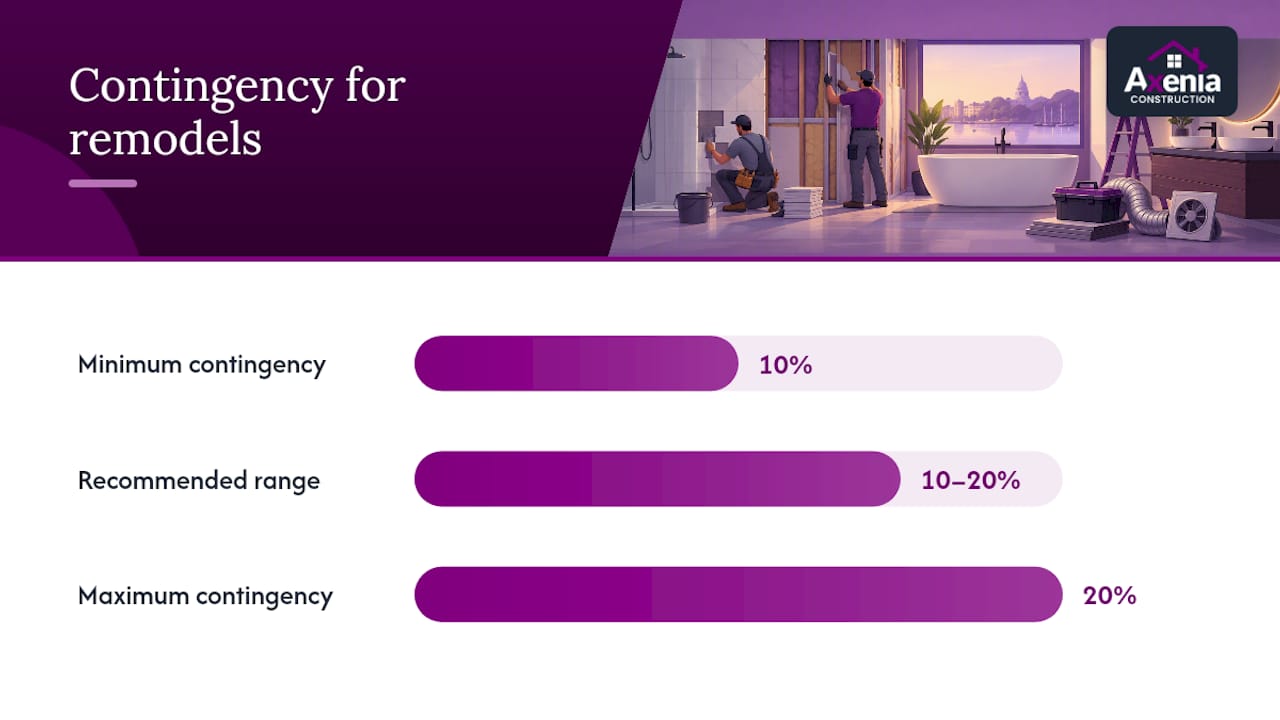
- Set aside a contingency of 10% to 20% of total project cost, leaning toward the higher end for any home built before 1980 where plumbing surprises are common.
Watch for vague change-order language, missing warranty terms, or a scope of work that does not specify tile brand, fixture models, or square footage. A clear scope of work document makes it much easier to hold every bidder to the same standard.
Pro Tip: Never accept a verbal change order. Get the price and scope change in writing before work continues, even for small adjustments.
Axenia Construction’s take on Maryland bathroom projects
We’re a women-owned, licensed general contractor based in Rockville, and bathroom remodels are one of the projects where small technical details make the biggest difference in long-term satisfaction. A few practices we build into every project:
- Use moisture-resistant backer board behind tile, not standard drywall, to prevent future mold and rot issues.
- Size and duct exhaust fans correctly. Underspecified fans frequently underperform in real installations, according to Building America’s ventilation guidance, which is a common cause of lingering humidity problems.
- Specify EPA WaterSense fixtures where it makes sense, since replacing older toilets can save an average family about 13,000 gallons of water per year.
Pro Tip: Ask your contractor how exhaust fans are rated. A fan should be specified by delivered airflow at real-world static pressure, not just its box rating.
Managing design and construction under one roof also reduces the back-and-forth that leads to costly change orders later in a project.
Do you need a general contractor or can you manage subs yourself?
Any project involving plumbing moves, structural changes, or heavy permitting benefits from a licensed general contractor who can coordinate trades and inspections in sequence. Smaller cosmetic updates, like swapping a vanity or retiling in place, can sometimes be managed with individual subcontractors, though plumbing and electrical work still require licensed trades regardless of who manages the job. On larger projects, we phase demolition and construction to keep at least one bathroom usable for as long as possible.
— Arienne
What Axenia Construction offers Maryland homeowners
If your bathroom remodel involves permits, plumbing changes, or a full layout redesign, working with a design-build team can provide a single point of contact from concept through final inspection instead of juggling separate designers and trades yourself.
Our Kitchen and Bath Remodels service covers design, licensed trade coordination, and permit support for Maryland bathroom projects, and our broader Home Renovations work extends to full-home projects for homeowners planning more than one room. Before your first consult, gather:
- A rough budget range and any must-have fixtures or finishes.
- Photos of your current bathroom and any layout changes you’re considering.
- A general timeline, including hard deadlines like guests visiting or a home sale.
If your plan includes moisture-resistant finishing work behind tile, our partners at Wendell Barco Plastering walk through what proper drywall finishing looks like once framing is done. To see completed examples in the region, browse our Bethesda bathroom remodeling project, or reach out for an estimate to start planning your project.
Where to verify permits, fixtures, and ventilation rules
Before finalizing your budget, check these official sources directly.
- Baltimore County’s bathroom alteration permit page explains the online application process and accepted fee payment methods.
- Prince George’s County’s alteration permit page defines what qualifies as an alteration and points to MHIC licensing rules.
- EPA WaterSense’s bathroom faucets page covers water-saving faucet options worth including in your fixture allowance.
- Energy details ducting best practices that prevent moisture problems after the remodel is complete.
Sources
- EPA WaterSense — Residential Toilets
- Bathroom Alteration Permit | Baltimore County Government
- Alteration | Prince George’s County
- Building America ventilation guidance (DOE)
- Energy
FAQ
Is $10,000 enough to remodel a bathroom in Maryland?
For many homeowners, $10,000 covers a basic to low mid-range refresh: new fixtures, updated flooring, and paint, without moving plumbing. It typically will not stretch to a full layout change or custom tile work in most Maryland markets.
Is $5,000 enough to renovate a small bathroom?
A basic cosmetic update such as a new toilet, vanity, and paint typically falls within the lower range of a basic bathroom refresh, which can start around $4,000, especially in small powder rooms. It rarely covers new tile work or any plumbing relocation, which push costs higher quickly.
What is a realistic budget for a bathroom remodel in Maryland?
A realistic mid-range budget for most Maryland homeowners typically covers new fixtures, tile, and a vanity without major layout changes, with costs varying by project specifics. Homeowners planning a full gut remodel with plumbing moves should budget closer to $25,000 to $55,000.
What is the most expensive part of a bathroom remodel?
Labor is usually the largest line item, often 35% to 60% of total cost depending on scope. Plumbing relocation is frequently the single biggest variable cost, adding $1,500 to $4,000 when supply lines or drain stacks need to move.
Recommended
- Bathroom Remodeling in Bethesda, MD: Increase Comfort, Luxury & Home Value –
- Luxury Bathroom Remodel Companies in Potomac, Maryland: What Homeowners Should Know Before Renovating – Axenia Construction
- Top Home Remodeling Tips in Maryland for 2026: Boost Value & Comfort – Axenia Construction
- Remodeling Companies in Maryland: What Homeowners Need to Know