
Clear one flat surface in the next ten minutes. That single act, an entry bench, a kitchen counter, or a nightstand, starts breaking the cycle of clutter in the home, and it works because visible progress builds momentum for the systems that keep clutter from coming back. The rest of this guide walks through why that matters and how to make it stick.
Grab a laundry basket or two boxes and sort whatever sits on that surface into three piles:
- Keep — put it away immediately, right now, not later
- Donate or sell — bag it and set it by the door
- Toss or recycle — trash goes out today
Less visual noise on one surface tends to lower stress almost immediately and makes the next task easier to start. The sections ahead cover the research behind that feeling, a step-by-step quick-start plan, a room-by-room checklist, and the habits that keep a decluttered home from sliding back into chaos.
Key Takeaways
Reducing clutter in the home works when a fast initial purge is paired with an environment designed to keep items in their place.
| Point | Details |
|---|---|
| Start with one surface | Clear a single counter or entry bench in 10 minutes to build momentum for the rest of the plan. |
| Clutter raises stress markers | Cluttered homes are linked to patterns of altered cortisol levels associated with chronic stress, per Psychology Today. |
| Use time-boxed methods | The 12-12-12 challenge and 1-3-5 rule cut decision fatigue by capping how much you sort per session. |
| Assign every item a home | Clutter returns when items lack a designated spot; fix container size and location before blaming habits. |
| Know when to call a pro | Safety hazards, mobility limits, or hoarding-level clutter call for an organizer, cleaner, or contractor. |
Table of Contents
- Why Clutter in the Home Affects Your Stress and Focus
- How Do You Start Decluttering When Everything Feels Overwhelming?
- Room-by-Room Clutter Checklist for Every Part of the House
- Building Systems That Keep Clutter From Coming Back
- When Structural Clutter Needs a Professional, Not Just a Weekend
- What Actually Moves the Needle on Clutter
- Frequently Asked Questions
- Sources
Why Clutter in the Home Affects Your Stress and Focus
Clutter is not just an eyesore. Researchers studying women’s daily cortisol patterns found that those who described their homes as cluttered showed flatter diurnal cortisol slopes, a pattern associated with chronic stress rather than the normal rise-and-fall rhythm healthy stress hormones follow, according to reporting in Psychology Today. Your body reads a messy house the way it reads an unfinished task list: something that never gets resolved.
A cluttered environment can keep your stress response switched on longer than it should be, even when nothing dramatic is happening around you.
That matters because chronic, low-grade stress wears on focus, mood, and sleep over time, not just in the moment you’re staring at a messy counter. Broader academic work backs this up: subjective clutter, meaning how cluttered a space feels to the person living in it, strongly predicts lower wellbeing and a weaker sense of psychological home, independent of how much stuff is actually there, according to a study published in Behavioral Sciences. Two people can own the same amount of stuff and feel entirely different about their homes.
The practical costs pile up alongside the psychological ones. Clutter increases:
- Time lost searching for keys, mail, or tools that have no assigned home
- Fall risk, particularly on stairs, hallways, and around furniture with items left underfoot
- Cleaning difficulty, since you can’t wipe a counter or vacuum a floor that’s buried
- Distracted attention, as visual clutter competes for the same mental bandwidth you need for work or conversation
Decluttering and organizing reduce stress and improve mood and daily functioning, and researchers describing this connection have noted that organizing can reverse many of the negative effects tied to disorganization, according to National Geographic. That’s the encouraging part. Unlike a lot of stress triggers, this one responds directly to action you can take this weekend, and often improves outcomes like sleep quality and fall risk along the way, per reporting from Verywell Mind.
How Do You Start Decluttering When Everything Feels Overwhelming?
Momentum beats motivation. The plan below is built in time blocks so you can see results before you get tired of the project, and it borrows structure from three well-documented methods: the room-by-room sorting philosophy behind KonMari, the 12-12-12 challenge (find 12 items to toss, 12 to donate, and 12 to put back where they belong), and the 1-3-5 rule for daily task management, all of which are outlined as effective, low-friction tactics by Healthline.
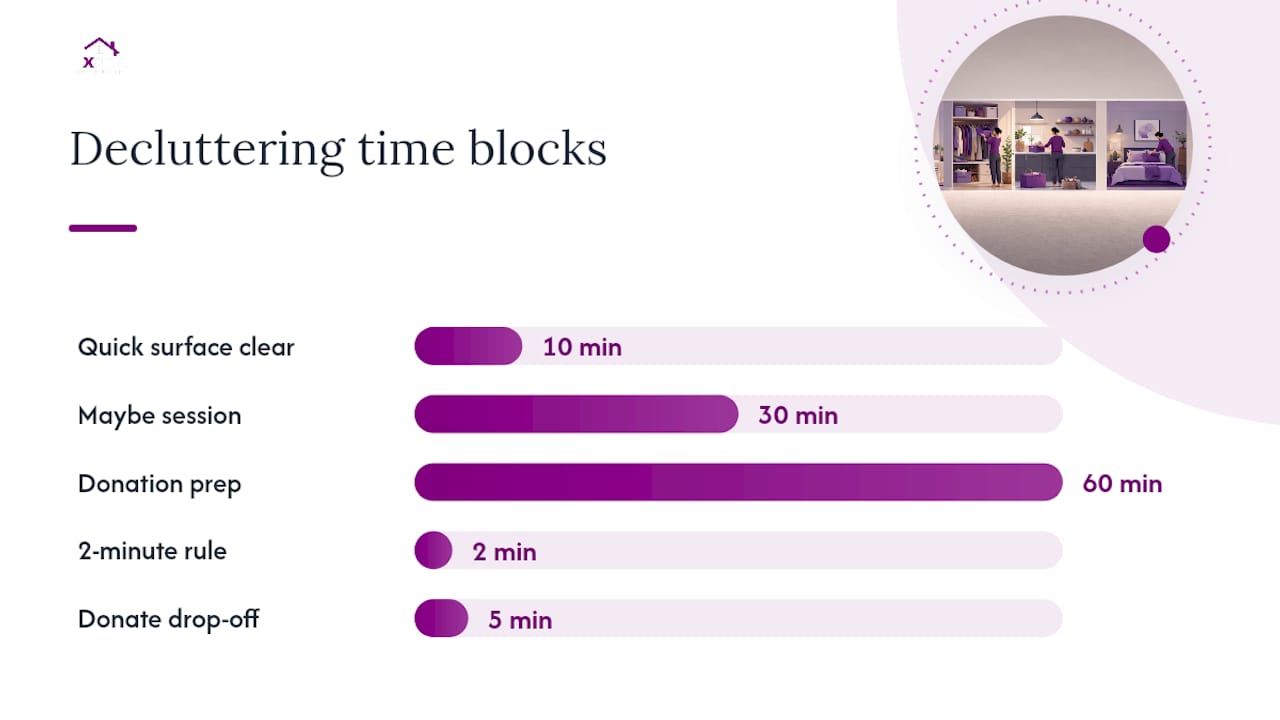
- Set a timer for 10 minutes and clear one flat surface completely. Sort into keep, donate, toss.
- Move to a 30-minute “maybe” session. Pull everything from one drawer, shelf, or closet section into a pile. Anything you can’t name a use for in the next ten seconds goes into a box marked “revisit in 30 days.”
- Spend 60 minutes prepping donations. Bag clothing, small appliances, and books. Load the car or schedule a pickup so the bags don’t become a new pile.
- Apply the 2-minute rule to anything you touch during cleanup: if putting it away takes less than two minutes, do it immediately instead of setting it down “for now.”
- Run a 12-12-12 sweep through one room: 12 items tossed, 12 donated, 12 returned to their proper spot.
- Tackle paperwork separately. Sort mail into act now, file, and shred piles. Recycle anything older than a year unless it’s tax-related or a warranty you still need.
- Corral small daily clutter, chargers, keys, sunglasses, into a single tray or drawer near the door so it stops colonizing every counter.
- Set your one-in-one-out rule starting today: nothing new comes in without something old going out.
Sorting categories matter more than people expect. Instead of just keep-or-toss, use five bins: keep, donate, toss, relocate (it belongs in another room), and recycle. That fifth category catches a surprising amount, old electronics, cardboard, glass jars, that otherwise ends up shoved back into a drawer because “toss” felt wasteful and “keep” felt wrong.
Pro Tip: Keep a permanent donation box in a closet year-round. Every time you spot something you no longer use, drop it in immediately instead of waiting for a big cleanup day. By the time the box is full, donating it takes five minutes.
The 12-12-12 and 1-3-5 templates work because they cap the decision-making. Decision fatigue, not laziness, is usually what stalls a decluttering project halfway through. Giving yourself a number to hit (12 items, or 1 big task plus 3 medium plus 5 small) removes the paralysis of an open-ended “declutter the house” goal that never feels finished.
Room-by-Room Clutter Checklist for Every Part of the House
Different rooms accumulate clutter for different reasons, so a single strategy rarely works everywhere. Here’s what to prioritize room by room.
Entryway or drop zone
- Install hooks at two heights (adult and kid) so coats and bags stop landing on chairs
- Keep a donation bag hanging inside a coat closet, visible enough to use
- Designate a small basket or tray as the only legal landing spot for keys, mail, and sunglasses
Kitchen
- Clear counters first. Anything that hasn’t been used in 30 days gets stored or donated.
- Audit duplicates. Most kitchens have three can openers and one that works.
- Check the fridge and pantry for expired items and consolidate half-used boxes into containers.
- Purge small appliances that serve one narrow purpose and haven’t been used this year.
Living room
- Use a single basket or ottoman with storage to corral remotes, blankets, and stray toys
- Rotate toys or games in and out of a closet instead of keeping everything accessible at once
- Route cords through a cable box or along baseboards to cut visual clutter without buying new furniture
Bedrooms and closets
- Pull every piece of clothing out and try it on if you’re unsure, this is the step most people skip and the one that saves the most closet space.
- Sort into keep, donate, and a “maybe” bin you revisit in three months.
- Assign a specific shelf, bin, or hook to each category of item, shoes, bags, seasonal wear, so nothing floats.
Bathroom
- Toss expired medications, sunscreen, and makeup (check the little jar symbol on the packaging for shelf life)
- Keep a small daily-use basket for the three or four products you actually reach for each morning
- Store backups under the sink in labeled bins instead of loose on a shelf
Paperwork and digital clutter
- Triage mail the day it arrives: act now, file, or shred.
- Scan anything you need to keep long-term and shred the paper copy.
- Spend fifteen minutes unsubscribing from retail emails that prompt impulse buys.
Garage and attic
- Triage by category (tools, seasonal decor, sports gear) rather than trying to sort the whole space at once
- Schedule a specific weekend for bulky items rather than letting them linger indefinitely
- If the space is genuinely overflowing, treat it as a storage capacity problem, not a tidiness problem, which is where a finished basement or added storage can solve what organizing alone can’t
Building Systems That Keep Clutter From Coming Back
A decluttered home doesn’t stay that way through willpower. It stays that way because the environment makes tidiness the path of least resistance. Assign every item a specific “home,” a shelf, hook, or bin it always returns to, and clutter stops accumulating because there’s nowhere for it to drift.

Maintenance rhythms matter as much as the initial purge. A five to ten minute daily reset (clearing counters, running dishes, putting shoes away) prevents the small pileup that turns into a weekend project. Add a weekly 20 minute edit of one problem zone and a monthly scan of closets or the garage, and clutter management becomes a habit instead of an emergency.
A few behavioral rules make the biggest difference:
- Full-hands rule: never walk past a room empty-handed if something in it belongs somewhere else
- One-in-one-out: a new sweater means an old one leaves
- Shopping pause: wait 24 hours before buying non-essentials to cut impulse clutter at the source
- Standing donation bag: keep it accessible so giving something away takes seconds, not a special trip
Pro Tip: If a system keeps failing, the problem is usually friction or container size, not discipline. A bin that’s too small forces overflow onto the floor next to it. A hook placed two steps out of the way gets ignored. Fix the container or its location before blaming the habit.
Effective organizing methods vary by household, and matching the system to how your family actually moves through a space, rather than copying someone else’s setup exactly, produces routines that last longer than a few weeks, according to organizing guidance from Life A Go Go.
When Structural Clutter Needs a Professional, Not Just a Weekend
Some clutter problems aren’t organizing problems. If stacks block exits, stairs are impassable, mobility is limited, or the volume of items suggests hoarding disorder rather than ordinary mess, it’s time to bring in outside help rather than push through alone, a threshold clinical guidance from WebMD treats as a real red flag, not an overreaction.
Different professionals solve different pieces of the puzzle:
- Professional organizers build sorting systems and coach households through the emotional side of letting go
- Cleaning services handle the deep clean once volume comes down
- Donation pickup organizations, including groups like Dress for Success, remove usable items sustainably instead of sending them to a landfill
- General contractors solve the structural cause when clutter keeps returning because the house simply lacks storage
That last category is where Axeniaconstruction spends most of its time. A mudroom with built-in cubbies, a pantry with real cabinetry, or a reconfigured closet system changes the math entirely because clutter often returns not from bad habits but from too little dedicated storage for how a family actually lives. Before hiring, define your scope, budget, and timeline; our home renovation project planning guide walks through exactly how to prepare.
What Actually Moves the Needle on Clutter
Most decluttering advice treats tidying as a single event: clear the mess, feel better, done. The research says otherwise. The cortisol data out of the UCLA-linked reporting matters less as a scare statistic and more as proof that clutter is a chronic stressor, which means a one-time purge without a maintenance rhythm just resets the clock until the same stress pattern returns.
The conventional wisdom oversells willpower and undersells container design. Most “failed” organizing systems weren’t undone by laziness. They were undone by a bin that was too small or a hook nobody could reach without effort. Fix the friction, not the person.
If your clutter keeps returning to the same three spots no matter how often you clear them, that’s usually a storage capacity problem, not a habit problem, and no amount of KonMari folding fixes a house that simply lacks a mudroom or a real pantry.
Frequently Asked Questions
What causes clutter in a home to keep coming back?
Clutter returns when items don’t have an assigned home or when storage containers are too small for what a household actually owns. Fix the system, not just the mess, and the same pileup won’t reappear in the same spot every few weeks.
How long does it take to declutter a whole house?
It depends on the home’s size and how much has accumulated, but a room-by-room approach using time-boxed sessions (10, 30, or 60 minutes) makes steady progress without requiring a single overwhelming weekend.
What is the 12-12-12 decluttering method?
It’s a simple challenge: find 12 items to throw away, 12 to donate, and 12 to return to their proper place. It works well as a quick session inside any single room.
When should I hire a professional organizer instead of doing it myself?
Consider a professional organizer, hoarding specialist, or general contractor when clutter presents safety hazards, limits mobility, or keeps returning despite repeated efforts, since that pattern usually points to a structural storage gap rather than a habit problem.
Sources
- Being organized can actually improve mental health. This is why. | National Geographic
- Clear space, clear mind: The science behind decluttering | Psychology Today
- How to declutter and why | Healthline
- Home and the extended-self: Exploring associations between clutter and wellbeing (Behavioral Sciences/MDPI)