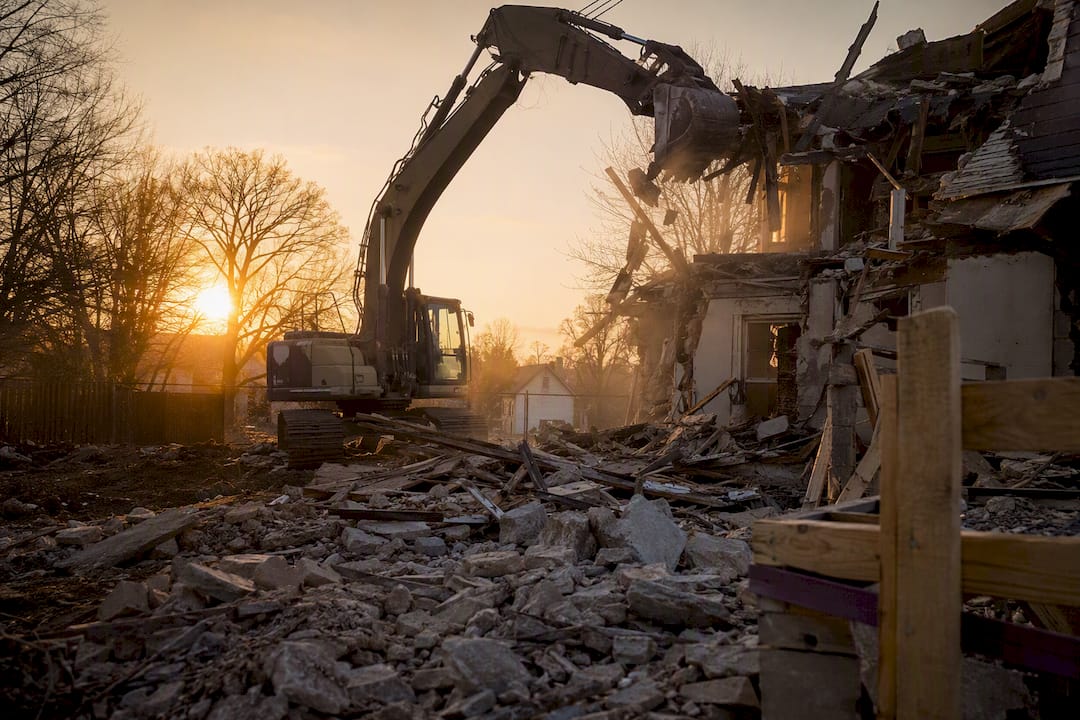
The demolition phase is the engineered sequence of surveys, permits, hazardous-material abatement, site preparation, active teardown, and final cleanup that transforms a structure into a clear buildable site. It is not one event but a chain of dependent steps, each one governed by codes and safety rules that determine what can happen next.
At Axeniaconstruction, we tell clients that demolition activities generally fall into these buckets:
- Pre-demolition engineering survey and structural assessment
- Permits and municipal approvals
- Utility disconnection and coordination
- Hazardous-material testing and abatement
- Site preparation and safety setup
- Active teardown (mechanical, selective, or manual)
- Debris removal, sorting, and recycling
- Final inspection and site clearance
Federal standards shape nearly every one of these steps. OSHA Subpart T governs the technical requirements, the EPA’s debris guidance shapes how waste gets handled, and a mandatory engineering survey by a qualified professional has to happen before anyone swings a sledgehammer.
Key Takeaways
The demolition phase succeeds when the engineering survey, permits, and hazardous-material abatement are fully documented before any structural teardown begins.
| Point | Details |
|---|---|
| Engineering survey comes first | A competent-person survey with written documentation is required before demolition starts and drives most citations. |
| Abatement precedes structural work | Asbestos and lead testing must clear, and abatement must finish, before teardown begins. |
| Sequencing runs top down | Load-supporting members can’t be cut until the story above is removed and shored. |
| Permitting outlasts teardown | Active demolition often takes 1 to 3 days, while permits and abatement can take weeks. |
| Axeniaconstruction coordinates the full sequence | As a licensed general contractor, Axeniaconstruction manages surveys, permits, abatement subcontractors, and inspections under one point of contact. |
Table of Contents
- What Does the Demolition Phase Involve, Step by Step?
- What Happens Before Demolition Begins?
- How Does Active Demolition Actually Work?
- What Safety Rules Govern Demolition Sites?
- How Is Demolition Debris Sorted and Disposed Of?
- Who Should You Hire to Run a Demolition Project?
- What Should Homeowners Do Before and During Demolition?
- How Does a Licensed Contractor Manage the Demolition Phase?
- What Contractors Wish Homeowners Knew About Demolition
- Let a Licensed Contractor Handle the Coordination
- Sources
What Does the Demolition Phase Involve, Step by Step?
Break the phase into subphases and the schedule starts to make sense. First comes pre-demolition planning and the engineering survey. Then permitting and utility coordination run in parallel with scheduling. Hazardous-material abatement follows, strictly before any structural work begins. Site preparation comes next, then active demolition, then debris removal and recycling, then the final inspection that closes out the permit.
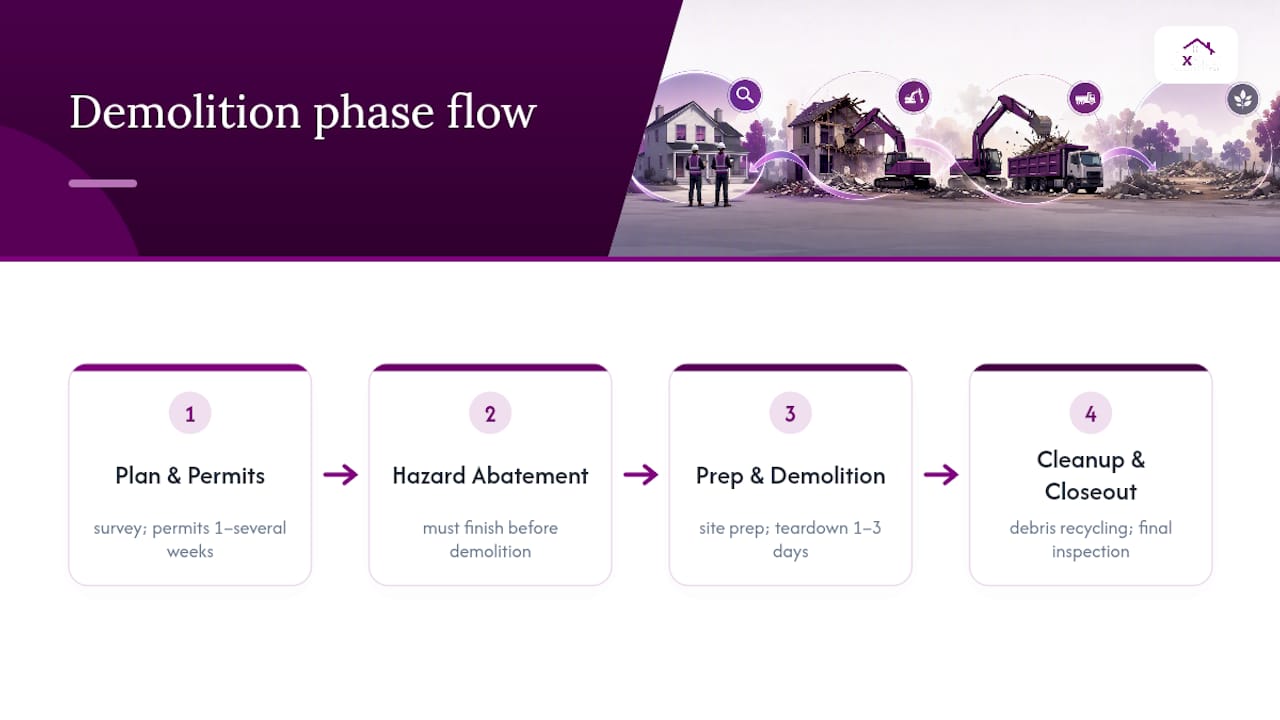
For a typical single-family residence, the active teardown itself often takes just 1 to 3 days. What eats the calendar is everything around it. Permitting alone can take one to several weeks depending on your jurisdiction, and if asbestos or lead paint turns up during testing, abatement adds more time before crews touch a wall.
Some tasks overlap. Permit review can proceed while your contractor lines up utility disconnections and orders dumpsters. Other tasks cannot: hazardous-material abatement must finish before structural demolition starts, full stop. Complex structures, additions built without permits, or tight urban lots with limited access all stretch the timeline further. A simple detached garage might clear in two weeks start to finish. A two-story home with an asbestos-tiled basement can run six to eight weeks before a single wall comes down.
What Happens Before Demolition Begins?
Everything before the first swing is about controlling risk, and it starts with the engineering survey. OSHA requires that a competent person inspect the structure before demolition begins, documenting framing conditions, load paths, and any area at risk of unplanned collapse. Employers must keep written evidence that this survey happened, because this single requirement drives a large share of demolition citations nationwide.
Permits come next, and requirements vary by municipality. Expect to need a demolition permit, possibly a separate grading or erosion-control permit, and sign-off from your utility providers. Lead times run anywhere from a few days to several weeks. Before any digging or utility work, call 811 to have underground lines marked, and get written utility disconnect confirmations for gas, electric, and water.
Hazardous-material testing is not optional on older homes. Licensed inspectors test for asbestos, lead paint, and occasionally PCBs, and any abatement work must happen before structural demolition starts. Municipalities and the EPA typically require documentation of abatement completion before issuing final demolition clearance.
- Engineering survey with written documentation
- Demolition permit and any required sub-permits
- Utility disconnect confirmations (811 call plus provider sign-off)
- Hazardous-material test results and abatement certificates
Pro Tip: Keep a physical or digital folder with every survey report, permit, and abatement certificate as soon as you receive it. If a dispute or inspection question comes up later, having dated paperwork on hand saves weeks of back-and-forth.
How Does Active Demolition Actually Work?
Most residential jobs use mechanical demolition with excavators, or selective soft-strip removal for partial teardowns. Manual removal handles delicate interior work like salvaging fixtures. Implosion with controlled explosives is a large-structure method almost never used on residential properties, so don’t expect it on a typical home project.

Sequencing rules exist for a reason. Work proceeds from the top down: ornamentation and nonload elements come off first, and load-supporting members cannot be cut until the story above them is already removed and any needed shoring is in place. Skip that order and you risk an unplanned collapse.
On-site controls back up the sequencing: exclusion zones keep bystanders clear, shoring and bracing stabilize weakened sections, dust suppression keeps particulates down, and enclosed chutes with barricades manage falling debris safely.
Structural members that support floors or walls should never be cut or removed until the story or areas above them have been demolished and, where necessary, shored. That single rule prevents most demolition collapse incidents.
Pro Tip: Ask your contractor whether the crew holds a daily toolbox talk before work starts. A five-minute safety briefing each morning is one of the simplest, most effective habits on any demolition site.
What Safety Rules Govern Demolition Sites?
OSHA Subpart T (29 CFR 1926.850 through 1926.860) is the regulatory backbone for demolition work, covering everything from preparatory operations to chutes, storage, and mechanical or explosive methods. The engineering survey requirement under 1926.850(a) gets cited so often that it reportedly accounts for up to three-fourths of demolition-related citations, which tells you how often this step gets skipped or documented poorly on job sites.
Beyond the survey, expect these minimum protections on any legitimate demolition site:
- Utility lockout and tagout before work begins
- Shoring or bracing wherever collapse risk exists
- Marked exclusion zones around active work areas
- Enclosed chutes and barricaded debris drop zones
- A written emergency and fire response plan
- Documentation retained for surveys, permits, and abatement
Demolition carries additional hazards beyond standard construction work: hidden asbestos, post-tensioned concrete, and unplanned design changes that a competent-person survey is meant to catch before they become emergencies.
As a homeowner, ask your contractor directly whether they can produce written survey documentation and a site safety plan. If they hesitate, that’s a red flag worth taking seriously.
How Is Demolition Debris Sorted and Disposed Of?
Debris typically separates into wood, metal, masonry, and hazardous waste streams, and professional separation cuts both landfill costs and environmental impact. Enclosed chutes move material safely from upper floors, roll-off containers stage it on site, and covered trucks haul it to certified recycling or disposal facilities. Hazardous streams need manifested tracking from removal through final disposal.
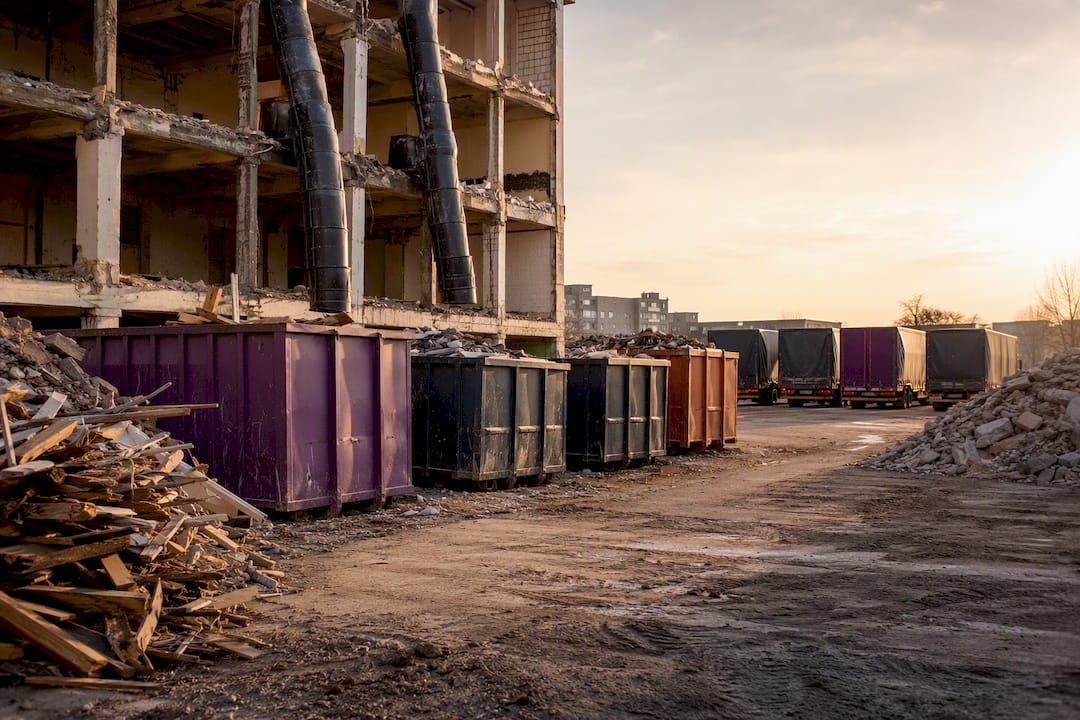
EPA guidance on debris handling, originally built around disaster recovery, applies just as well to routine demolition: sort early, contain hazardous material separately, and document disposal.
Statistic Callout: Active mechanical demolition on a single-family home often wraps in just 1 to 3 days, while sorting, hauling, and disposing of the resulting debris can extend well past that window depending on volume and recycling capacity.
Pro Tip: Ask your contractor what percentage of debris they expect to divert from landfill. A contractor with a real diversion target usually has an established relationship with recycling facilities, not just a hauling contract.
Who Should You Hire to Run a Demolition Project?
Verify a general-contractor license where your jurisdiction requires one, along with proof of general liability and workers’ compensation insurance. Ask for written evidence that a competent-person engineering survey will be performed and documented. If asbestos or lead paint is present, confirm the abatement subcontractor holds a separate, current license for that work.
In your contractor interview, ask directly about sequencing plans, daily safety briefings, and how debris will be sorted and hauled. Request a copy of their insurance certificate before signing anything.
- General-contractor license (where applicable)
- Active GL and workers’ compensation coverage
- Written engineering survey documentation
- Separately licensed abatement subcontractor if hazardous materials are present
On most residential jobs involving hazardous materials, expect a multi-subcontractor team: a licensed abatement crew handles asbestos or lead removal, then a separate demolition crew takes over structural teardown. Your general contractor should coordinate both and remain the single point of accountability, a role we outline further in our subcontractor selection guide.
What Should Homeowners Do Before and During Demolition?
- Remove valuables and relocate pets before crews arrive.
- Confirm utility disconnects or temporary relocations are scheduled.
- Get copies of every permit and survey document.
- Arrange temporary storage for anything you’re keeping.
Once work starts, confirm daily start times, ask about dust and noise controls, and get a direct emergency contact for the site.
- Before permits are pulled: remove valuables, arrange storage
- During permitting: confirm utility scheduling
- Day one on site: verify safety plan and emergency contact
How Does a Licensed Contractor Manage the Demolition Phase?
When Axeniaconstruction takes over a demolition scope, the sequence starts with confirming exact project boundaries, then ordering the engineering survey, pulling permits, and scheduling utility disconnects and abatement subcontractors before any teardown begins. Daily safety briefings run throughout active work, and the phase closes with a documented final inspection handoff.
Homeowners working with a licensed general contractor should expect to receive:
- Copies of the engineering survey and permits
- A written site safety plan
- Abatement completion certificates, if applicable
- A final inspection sign-off before cleanup crews demobilize
This is the same coordination model we describe in our construction process overview.
What Contractors Wish Homeowners Knew About Demolition
The hardest tension on any demolition site isn’t the wrecking itself. It’s the pressure to move fast against the discipline sequencing demands. A homeowner eager to see progress sometimes asks why crews haven’t touched a load-bearing wall yet, not realizing the floor above still needs to come down first.
Watch for a contractor who explains the sequence before you ask, and who treats a delayed step as a safety decision rather than an inconvenience.
Let a Licensed Contractor Handle the Coordination
Managing surveys, permits, abatement subcontractors, and daily site safety across a demolition project takes real coordination, and most homeowners have neither the time nor the licensing to do it themselves. Axeniaconstruction is a licensed, locally owned general contractor serving residential and commercial clients, and we manage that entire sequence so you don’t have to track down separate abatement crews, permit offices, and utility companies on your own.

We handle the paperwork trail, from engineering survey documentation through final inspection sign-off, and coordinate every subcontractor under one point of contact. If demolition is the first step in a larger renovation, our residential renovation guide walks through what typically comes next. Ready to talk through your project? Reach out to Axeniaconstruction to schedule a consultation and get a clear scope before any permits get filed.
Sources
For the full regulatory text, permit templates, and deeper technical guidance, consult these primary sources:
- 1926.850 – Preparatory operations
- Dealing with debris and damaged buildings | EPA
- Demolition Timeline: How Long Does a Demolition Project Take | Demolition Authority
Check with your local building department for permit-specific requirements, since these vary by jurisdiction.